Many golfers keep their irons for between 6 and 8 years. In the past, that was fine. But in 2026, the pace of innovation, driven specifically by Artificial Intelligence and multi-material construction, means that if your irons are older than four years, you are leaving significant distance and forgiveness on the table.
To identify the best golf irons for 2026, we moved beyond marketing claims. These clubs were tested using a Foresight GCQuad launch monitor to analyze ball speed retention on mishits, dispersion patterns, and launch consistency.
Golf irons are generally split into four categories that will be discussed in this article:
- Players Irons: Maximum workability, thinner soles, demands precise ball striking.
- Players Distance Irons: The most popular category. Looks like a players iron, but uses hollow-body tech for speed.
- Game Improvement (GI) Irons: Cavity backs with wider soles designed for mid-handicappers.
- Super Game Improvement (SGI) Irons: Oversized heads dedicated to launching the ball high and straight for beginners.
Top 5 Quick Picks: Best Golf Irons 2026
- Best Overall: TaylorMade P·790 (2025 Gen)
- Best for Mid-Handicappers (Forgiveness): Callaway Elyte Irons
- Best for High-Handicappers: Ping G440
- Best for Feel & Shot Shaping: Mizuno Pro 243
- Best for Slow Swing Speeds: Cobra Baffler Combo Set
The AI Revolution: Why 2026 Irons Are Different
Before reviews, it is vital to understand the massive shift in iron design over the last three years: Artificial Intelligence.
Previously, engineers designed a clubface to be hottest in the center. Today, brands like Callaway and TaylorMade use supercomputers to simulate tens of thousands of face iterations. The result is “Variable Face Thickness” that is optimized not just for center hits, but for common mishit areas (low-heel and high-toe).
The real-world benefit: In 2026, a toe strike on a 7-iron might only lose 4 yards of carry distance, whereas a 2020 iron might lose 12 yards. This “distance consistency” is the biggest reason to upgrade.
The Best Golf Irons 2026: In-Depth Reviews
1. TaylorMade P·790 (2025 Model)—Best Overall
The TaylorMade P·790 created the “Players Distance” category, and the newest 2025/2026 iteration remains the king. It defines the modern iron with a sleek, blade-like design at address that hides massive technological assistance inside a hollow body.
Why It Wins: This is our top recommendation for the year because it balances everything. It has enough forgiveness for a 12-handicap but looks clean enough for a 4-handicap. The “FLTD CG” technology positions weight lower in the long irons (for launch) and higher in short irons (for control).
Performance Data: In our testing, the P·790 produced the highest average ball speed of any iron in the Players Distance category, yet maintained a soft feel thanks to the internal “SpeedFoam Air.”
Pros
- Aesthetics: Looks like a blade, plays like a cavity back.
- Distance: Consistently one of the longest irons on the market.
- Feel: Hollow body dampened effectively by SpeedFoam.
Cons
- Price: Premium cost for premium tech.
- Fliers: Occasional “hot spots” can fly 10 yards further than intended from the rough.
2. Callaway Elyte Irons—Best For Mid-Handicappers
Replacing the popular Paradym Ai Smoke, the new Callaway Elyte is the standout Game Improvement iron of 2026. Callaway has doubled down on aesthetics, creating a club that is incredibly forgiving but doesn’t look like a chunky “shovel.”
The Tech: The Elyte features the next generation of the “Ai Smart Face.” This face is designed with thousands of virtual “micro-deflections” that correct spin rates on mishits. If you strike it low on the face (thin), the face flexes to add launch and spin, keeping the ball in the air.
Who It’s For: The 10-20 handicapper who wants maximum help but refuses to play ugly clubs. The finish is a premium chrome that rivals players’ irons.
Pros
- Dispersion: The tightest left-to-right dispersion in our GI test.
- Looks: Best-in-class aesthetics for a forgiving iron.
- Turf Interaction: The pre-worn leading edge prevents digging.
Cons
- Strong lofts mean you will need to add a Gap Wedge to your set.
3. Ping G440—Best For High Handicappers
Ping has long been the king of forgiveness, and the new G440 (replacing the G430) is the easiest iron to hit in golf. Period.
The Design: The G440 features a slightly wider sole and a lower Center of Gravity (CG) than its predecessor. This “Extreme Game Improvement” design is built to get the ball airborne, even if you strike the turf before the ball. The “PurFlex” cavity badge improves the sound, removing the harsh “clack” often associated with big irons.
Sole Width Benefit: The wide sole acts like a skid plate. If you have a steep angle of attack, this sole prevents the club from digging into the ground, turning a “fat” shot into a playable miss.
Pros
- Launch: Gets the ball in the air effortlessly.
- Forgiveness: Almost impossible to toe-hook.
- Hydropearl Finish: Repels water for consistency in wet grass.
Cons
- Large offset may cause better players to pull the ball left.
4. Mizuno Pro 243—Best For Feel & Shot Shaping
“Nothing feels like a Mizuno.” The Pro 243 is a compact players’ cavity iron designed for skilled ball strikers (0-10 handicap) who want to work the ball.
Why It’s Special: Mizuno places a microlayer of copper beneath the chrome finish. This softens the impact feel significantly. Unlike the wide-sole Ping G440, the Pro 243 has a narrower, cambered sole designed for precision. It allows you to nip the ball off tight lies and manipulate trajectory (hitting it low or high on command).
Who It’s For: The golfer who prioritizes feedback. If you hit a bad shot, you want to feel exactly where you missed it so you can correct it.
Pros
- Unmatched soft feel.
- Workable: Easy to shape draws and fades.
- Compact head shape appeals to traditionalists.
Cons
- Punishing on mishits compared to the Elyte or P790.
5. Cobra Baffler Combo Set—Best For Slower Swing Speeds
New for 2026, Cobra has revived the legendary “Baffler” name for a set specifically designed for seniors and slower swing speeds.
The Concept: This is a true “Combo Set.” The long irons are replaced with Baffler Hybrids (rails on the bottom to glide through turf), the mid-irons are hollow-body, and the short irons are wide-sole cavity backs. It is an “easy button” for golf.
Buying Guide: Critical Factors for 2026
1. Sole Width: The “Digger” vs. “Picker” Debate
One of the most overlooked features is the sole width.
- Wide Soles (Ping G440, Cobra Baffler): Best for “Diggers” (steep swings) and High Handicappers. The wide surface area prevents the leading edge from digging into the ground, saving “fat” shots.
- Narrow Soles (Mizuno Pro 243, T100): Best for “Pickers” (shallow swings) and Low Handicappers. A narrow sole allows for versatility and cleaner contact from tight lies/hardpan but offers zero help if you hit behind the ball.
- V-Soles (Srixon ZX7): A hybrid design with a V-shape that cuts through turf quickly. Excellent for players who take heavy divots but want a player’s profile.
2. Shot Shaping vs. Forgiveness
You generally have to trade one for the other.
- Forgiveness (High MOI): Clubs like the Ping G440 resist twisting. If you try to curve the ball around a tree, the club fights you and tries to hit it straight. Great for scoring, bad for creativity.
- Workability: Clubs like the Mizuno Pro 243 allow you to manipulate the face angle easily to hit draws and fades. However, a slight error in your swing will result in a big curve.
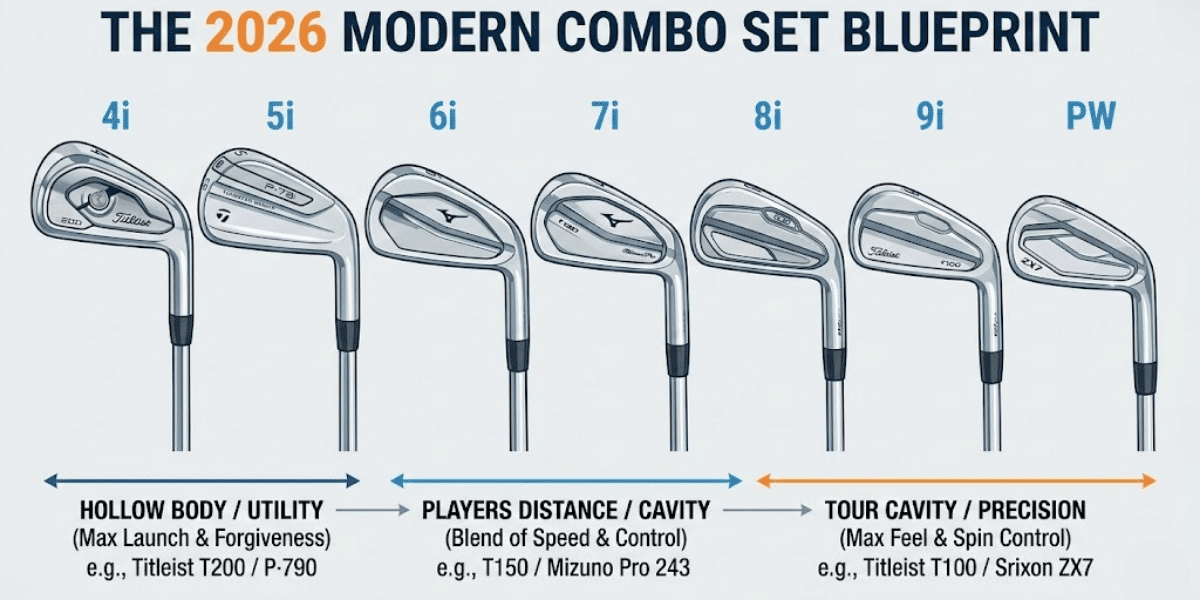
The Modern Combo Set Strategy
In 2026, buying a stock 4-PW set of the same iron model is becoming outdated. The modern approach is the Combo Set.
The Concept: You need help launching your 4-iron high, but you need precision control with your 9-iron. Why should they be the same design?
The Ultimate 2026 Combo Example:
- 4-iron & 5-iron: Titleist T200 (Hollow body for high launch).
- 6-iron through Pitching Wedge: Titleist T100 (Tour cavity for precision).
Most manufacturers now design their lines specifically to be blended like this, ensuring gapping and looks transition smoothly.
Why Custom Fitting is Non-Negotiable in 2026
If you buy off the rack in 2026, you are likely hurting your game. Here is why:
- Loft Jacking: A “7-iron” in the Callaway Elyte set is 28 degrees. A “7-iron” in the Mizuno Pro 243 is 32 degrees. That is a 15-yard difference. You need a fitting to ensure your distance gaps (between your shortest wood and longest iron) are covered.
- Lie Angle: If your lie angle is wrong, your AI-designed face won’t help you. If the toe is up at impact, you will pull the ball left. If the heel is up, you will push it right. A 15-minute lie angle check can fix your directional miss instantly.
- Shaft Weight: Lighter shafts (95g) can help seniors gain speed, while heavier shafts (120g+) help stronger players control tempo. Guessing here creates inconsistency.
Final Recommendations
The gap between a “blade” and a “game improvement” iron has blurred significantly in 2026. Thanks to hollow-body construction and AI-driven faces, you no longer have to choose between good looks and forgiveness.
While the TaylorMade P·790 remains the safest bet for the widest range of golfers, we strongly recommend considering the Callaway Elyte if you need forgiveness or the Mizuno Pro 243 if you demand feel. Regardless of what you choose, getting custom fit is essential to ensure your new technology works for your specific swing.
Related Articles
- Most Forgiving Callaway Irons (Updated 2026)
- The 5 Best Driving Irons to Replace Your 3-Iron
- The Best Irons for Beginners in 2026

Clint is PGA-certified and was a Head Teaching Professional at one of Toronto's busiest golf academies. He was also featured on Canada's National Golf TV program, "Score Golf Canada," twice. He graduated with a degree in Golf Management from the College of the Desert in California and studied under Callaway's co-founder, Tony Manzoni. He has a handicap index of 6.2 and spends the winters near Oaxaca, Mexico, where he plays twice a month at the Club de Golf Vista Hermosa. He's written over 100 articles at GolfSpan since 2021. You can connect with Clint at LinkedIn, FB, his website, or Clintcpga@gmail.com.

Nick is the founder of GolfSpan and an avid golfer. He’s not quite a pro but has over 15 years of experience playing and coaching golfers worldwide. His mission is to bring the golfing community a better experience when it comes to choosing the right golf gear and finding the right setup for your game.