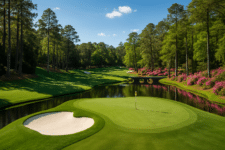
Most people who watch the Masters every April have no idea that the broadcasters calling the action are working from a vocabulary list.
Augusta National controls the language used to describe its tournament. Not just the etiquette on the grounds, not just the dress code for patrons. The words coming out of the broadcast booth. There is a style guide, and if you deviate from it, the consequences are real. Gary McCord made a joke about the greens in 1994 and has never called the Masters since. Tom Watson wrote a letter to the Augusta chairman describing McCord as the Howard Stern of golf. That was the end of it.
Here are the seven words and phrases that Augusta National has quietly removed from its broadcast, and why each one tells you something about how this tournament sees itself.
The people in the gallery aren’t fans. They are patrons.
This is the most well-known substitution, and if you’ve watched the Masters more than once you’ve already heard it without realizing it. The reasoning is worth knowing. The word “fan” derives from “fanatical,” and Augusta National doesn’t want that connotation attached to the people walking its grounds. Patrons suggests dignity. Fans suggests chaos. Augusta, predictably, prefers dignity.
There’s no front nine or back nine at Augusta National.
Every other tournament in professional golf uses front nine and back nine. At the Masters, broadcasters are required to say the first nine and the second nine. The reason, reportedly, is that “back nine” sounds too close to a reference to a person’s backside. Whether you find that charming or excessive probably depends on how much you enjoy this tournament in the first place. I find it charming. Augusta is Augusta.
Two players playing together form a pairing, not a twosome.
Three players form a grouping, not a threesome. The reasoning here doesn’t need much explanation. Augusta National simply prefers terms that carry no other meaning in everyday conversation. Foursomes never come up during tournament play, so that one was never added to the list.
The driving range is actually the tournament practice facility.
Augusta spent more than a hundred million dollars building the area where players warm up before their rounds. Calling it a driving range undersells it, and the club knows it. The official term is the tournament practice facility. Worth noting: only players competing in the Masters are permitted to use it. Even Augusta National members have their own separate practice area. The tournament practice facility is exclusively for the tournament.
There is no rough at Augusta. There is a second cut.
This is the one that surprises most people when they first hear it. Augusta National has rough. You’ll see players in it during every round. But you will never hear a broadcaster call it that. The official term is the second cut. The thinking is consistent with everything else about this place. Even the rough at Augusta National is maintained to a standard that most courses couldn’t match on their best fairways. Calling it rough feels like the wrong word for what it actually is.
Sand traps don’t exist here. Only bunkers.
Augusta National has 44 bunkers filled with white Spruce Pine sand sourced from North Carolina. Broadcasters refer to all of them as bunkers, never sand traps. This one is easier to defend than the others. Bunker is the more technically correct golf term regardless of where you are. It also sounds more appropriate for a major championship broadcast. Sand trap is a backyard word. Bunker is a golf word.
The large seating structures are not bleachers. They are observation stands.
Those big structures lining the fairways at Augusta, the ones filled with hundreds of seats, are called observation stands. Not bleachers, not grandstands. Observation stands. Consistent with everything else on this list, the language elevates the experience rather than simply describing it. At Augusta National, even the seating has a more formal name.
The rule that goes beyond any printed list.
The seven substitutions above are the official ones. But there is a broader standard that no printed list can fully capture, and Gary McCord’s story is the clearest illustration of it.
In 1994, McCord was calling the Masters on CBS when he described the greens at Augusta as having been bikini waxed. He was trying to explain how slick they were. Tom Watson, one of the most respected figures in the history of the game, heard it and didn’t appreciate it. Watson wrote a letter to the Augusta chairman. McCord was removed from the broadcast and has not called the Masters since.
The word list is the floor, not the ceiling. Augusta National expects a certain tone from everyone describing its tournament, and that expectation doesn’t come with a complete written guide. You’re expected to understand it.
Why Augusta’s language rules say more than they seem to.
It would be easy to read this list and conclude that Augusta National is overly precious about its image. Maybe it is. But the effect of these rules is real. The Masters broadcast sounds different from every other tournament on television, and that difference is intentional. The language is part of the product.
It’s the same attention to detail that shows up everywhere at Augusta, from the white caddie uniforms that have been part of the tournament since the 1940s to the green jacket traditions that most fans know by heart and the broader Augusta traditions worth paying attention to beyond the leaderboard. Every detail is controlled. The broadcast booth is no different.
If you’ve ever watched the Masters and felt like something about it was unlike any other tournament, this is part of why. The language is deliberate, enforced, and occasionally career-ending.
Even the rough has a better name. (And honestly, at Augusta, it probably deserves one.)
Clint is PGA-certified and was a Head Teaching Professional at one of Toronto's busiest golf academies. He was also featured on Canada's National Golf TV program, "Score Golf Canada," twice. He graduated with a degree in Golf Management from the College of the Desert in California and studied under Callaway's co-founder, Tony Manzoni. He has a handicap index of 6.2 and spends the winters near Oaxaca, Mexico, where he plays twice a month at the Club de Golf Vista Hermosa. He's written over 100 articles at GolfSpan since 2021. You can connect with Clint at LinkedIn, FB, his website, or Clintcpga@gmail.com.