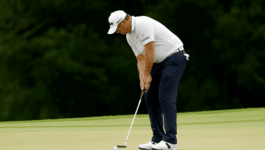
Nelly Korda teed off Sunday at the Chevron Championship at 12:08 p.m. Eastern. She was going for her third career major. She led by five shots. She was the most compelling player in women’s golf at the most important moment of her season.
Peacock didn’t start streaming until 1:30.
NBC didn’t go live until 2:00.
For an hour and twenty-two minutes, there was no way to watch. Not a backup stream. Not a Golf Channel window bridging the gap. Nothing. If you weren’t at Memorial Park in Houston, you were refreshing a leaderboard and hoping.
This Wasn’t a Surprise. That’s What Makes It Worse.
The final group teed off in threesomes. That scheduling decision was known in advance. The tee times were published. Someone looked at 12:08 and 1:30 and decided that gap was acceptable.
That is the part I can’t get past. This wasn’t a live television accident. It was a planned blackout at a major championship. With the world number two going wire-to-wire for her third major title. On a network that charges subscribers a monthly fee for exactly this kind of event.
Fans noticed. They were vocal about it. The response from NBC? Nothing. No explanation. No apology. That silence is its own statement.
CBS Did the Same Thing Two Weeks Earlier at Augusta
Rory McIlroy was standing over a tap-in putt to win back-to-back Masters titles. One of the most significant shots in recent golf history. CBS showed it from behind him. His body blocked the hole. Viewers couldn’t see the ball drop.
That same broadcast had already lost his second shot on 18, the approach from the pine straw that ended up in the bunker. For over a minute, nobody watching on television knew where the ball was. Not the announcers. Not the production truck. The fans at Augusta knew. The Masters.com feed knew. CBS did not.
Jim Nantz went on the Pat McAfee Show the following week and called it a mistake. He said it’s live television. He said his crew is the best in the business. Both things can be true, and the finish still got fumbled on the 72nd hole of the Masters.
Two Historic Moments. Two Networks. Zero Accountability.
What bothers me as a coach isn’t just the specific mistakes. It’s the pattern they reveal.
Golf has had two of the biggest moments of the year in the last month. Rory winning back-to-back at Augusta. Nelly Korda going wire-to-wire at the Chevron for her third major. Both moments were either botched in the broadcast or blocked from view entirely. In both cases, the network said close to nothing afterward.
That pattern has a name. It’s called getting away with it.
We Built This Problem Together
It’s easy to point at CBS and NBC. They deserve the criticism. But the story of how we got here is more complicated than that.
Fans wanted TV on phones. We wanted games on tablets. We wanted streaming without long commercial breaks. The industry responded. They gave us Peacock, Paramount+, and a fragmented landscape of apps and subscriptions. They gave it to us at higher prices, lower production quality, and with mid-stream ad insertion that interrupts at least as much as the old model did.
We accepted it. We kept subscribing. Every renewal is a signal that the product is good enough.
As long as the signal stays green, the product doesn’t have to improve.
The Attention Span Problem Is Real
The other piece of this that nobody wants to say directly: the outrage cycle is short. Golf fans were furious Sunday morning. By Tuesday, most of them had moved on. NBC knows this. CBS knows this. The conversation disappears into the scroll, and the next event comes around, and everyone tunes back in.
That’s not a criticism of fans. It’s the reality of how attention works in 2026. Corporations set their standards based on what they can get away with over time. If the answer is almost anything, the product reflects that.
The only lever fans actually have is sustained pressure or genuine churn. Cancel the subscription. Contact the network. Make enough noise that it costs them something beyond a news cycle. Short of that, the incentive structure doesn’t change.
What I’d Actually Like to See
Full live streaming from the first tee shot at every major. No blackout windows. If a player of Nelly Korda’s caliber is going for a third major title in a wire-to-wire performance, the coverage starts when she does. The technology exists. The decision to use it is a choice.
For CBS at Augusta, it’s simpler. Put a camera in front of the man when he’s putting for the championship.
Golf deserves better than this. Its players are putting on some of the most compelling performances in the sport’s history right now. The broadcasts covering those performances need to be worthy of them.
How do you think we actually fix this? Is it on the fans, the networks, or the tours themselves to demand better? The current answer from the industry seems to be that it fixes itself when people stop caring enough to complain.
Clint is PGA-certified and was a Head Teaching Professional at one of Toronto's busiest golf academies. He was also featured on Canada's National Golf TV program, "Score Golf Canada," twice. He graduated with a degree in Golf Management from the College of the Desert in California and studied under Callaway's co-founder, Tony Manzoni. He has a handicap index of 6.2 and spends the winters near Oaxaca, Mexico, where he plays twice a month at the Club de Golf Vista Hermosa. He's written over 100 articles at GolfSpan since 2021. You can connect with Clint at LinkedIn, FB, his website, or Clintcpga@gmail.com.